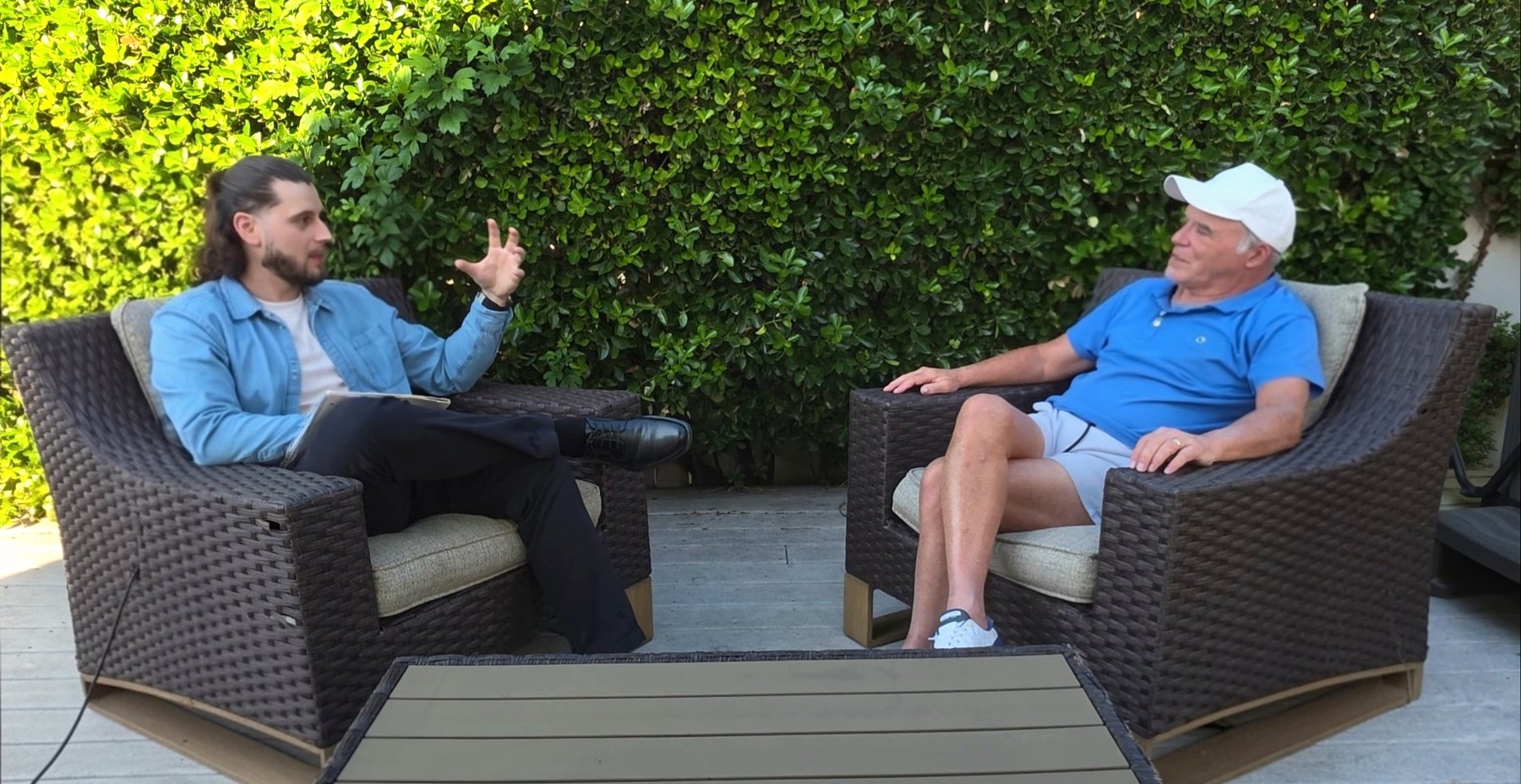
Said: This is a series where people who have experienced
injuries or surgeries that affect their day to day lives share their
experiences. We dive into their stories, talk about what they have endured, how
they have responded, and see where they are now.
My name is Said Haschemi, doctor of physical therapy and founder of Strength
Works. I am here today with Bob Cervoni. He is a retired financial executive,
and he is living with peripheral neuropathy affecting his lower legs, diagnosed
around 2020. Bob, tell me a little about what is going on.
Bob: Well, Said, it has been quite the journey. It all
started back in 2020. The very first symptoms I had were pain around my shins
when I was driving upstate to the country. I made that trip pretty often, and I
found that raising and lowering my toe to work the gas pedal was giving me pain
in the shin. So much so that at times I actually used my left leg to
accelerate. It got a little dangerous.
I ended up seeing an orthopedic doctor who thought the problem was maybe a
slipped disc in my spine, some type of spinal stenosis. He treated me for that,
including injections in the spine for the pain. Finally, when I told him I
really could not deal with the pain anymore, and I was starting to get numbness
in my toes, he scheduled me for surgery.
But before the surgery he said, I do want to do two final tests. One is
circulation in your feet. The other is an EMG, where they study the health of
the nerves in your feet. He sent me to a neurologist for that. The circulation
was fine. The neurologist was the one who said, you have a real problem with
the nerves in your feet, and we think you have peripheral neuropathy.
I knew nothing about it. I had never heard of it before. And there started
the journey to figure out the cause and what could be done for it.
Said: What was your level of function at that time? What
were you doing?
Bob: Right at the beginning it was minimal, just occasional
pain in the shin. But along the way the numbness increased, and the true
neuropathy pain, the tingling and burning, especially when you go to bed at
night. That increased, and it really affected the lifestyle I had.
And by the way, all of the diagnosis was very slow, because this was during
COVID. It was hard to get a doctor's appointment, and you probably did not even
want to leave the house at that time. It took a while, and I think that added
to the progression, not being able to do anything about it.
Once I got diagnosed, that started a whole battery of tests. More blood
tests than I knew existed. A spinal tap. DNA testing. A whole variety of
things, to try to figure out what was happening.
Said: Let me stop you there and take a step back. You
talked about how it affected your lifestyle. What was your lifestyle before all
of this pain? What were your go to hobbies, the things you have to think twice
about now?
Bob: I was an avid walker and hiker. I spent a lot of time
outdoors, fishing, hunting, riding ATVs, that type of thing. As the disease
progressed it started to affect balance, and that is when things took a
significant turn.
I was fairly active when I was younger. I played racquetball twice a week
until maybe my fifties. I am 73 now, so that was quite a while ago.
Said: With peripheral neuropathy affecting the lower legs
you are going to have some loss of strength. Foot drop is the name everybody
hears, and with foot drop you are going to experience some falls. Around that
time, was that a big issue?
Bob: I fell a few times early on, because you are not aware
of how the disease is affecting you, so you go about your normal routine. Then
I found that if I was wearing a soft rubber shoe and walking on a tile surface,
with a little bit of foot drop, you catch the floor and fall.
Since then I have become so aware, and with the training in physical therapy
that we will get into, I rarely fall now. But I am focused on it all the
time.
Let me add something. When the neurologist saw there was a problem, I will
never forget what he told me. He said, listen, I see one case like yours a
year. I am going to send you to somebody who sees five cases before lunch every
day of exactly what you have. So he sent me to a specialist in the city. This
man specialises in this. I have read books he wrote. I started joining
organisations that had panels and discussions about it, to understand what this
disease was.
After all of the testing, they narrowed it down to one potential cause: the
fact that I was pre-diabetic. It is very common in diabetics, but as a
pre-diabetic you can get the symptoms without being a full diabetic. So we went
down the protocol of making sure your A1C falls below the normal ranges. His
advice, and he was rather proud of it, was: keep your A1C under six, keep
exercising, and this will not get any worse. It may get a little better.
Well, that was not the case.
Something like 30% of people with peripheral neuropathy do not even know
what caused it, and they do not know what to do to make it better beyond the
general things. Low sugar, exercise, physical therapy, balance, gait training.
People try acupuncture, chiropractors. And then there is a whole slew of people
trying to sell you creams and pills and supplements that are supposed to help
this, and very few of them do anything at all.
Said: The general rule of thumb is that if something really
does work, there is usually a big wall of bureaucracy behind it. You need a
licence to even refer it. Most of the time these things are either placebo, or
they just do not do as much as we want. But you saw a lot of doctors. How was
that process?
Bob: Had the diagnosis been correct, I would have been
thrilled. But with what they call idiopathic peripheral neuropathy, where they
really do not know the cause, it is very tough. That is disappointing.
As a matter of fact, the doctor was surprised. As this progressed it really
got into balance issues. That is the main thing. The nerve pain I had early on
actually subsided a bit.
I have tried everything. Red light therapy, everything you could imagine,
and spent a lot of money doing it. None of it really worked. The things that
worked best were the physical therapy. The acupuncture helped somewhat. Losing
weight helped a lot. Right now, maintaining balance is the big thing.
Said: Was losing the weight more about the pain in the
foot, or about agility?
Bob: No, it was from a health perspective. By losing the
weight you can maintain your glucose levels lower and more easily.
Some people say alcohol is a big problem, but there are so many different
types of peripheral neuropathy that you do not know where they are coming from.
I am not a big drinker at all. A glass of wine with dinner, maybe one cocktail,
a couple of times a week. That is all.
But you have to keep moving, and you cannot let the disease depress you. You
have to be a glass half full kind of person. I am happy for what I do. I am
happy that I can lead a pretty normal life. My loved ones are understanding.
But if I have to walk down to the mailbox, it is a chore. I do not like walking
now. You do it when you have to, and you get your exercise otherwise.
Said: Did you ever try anything to help with the walking,
like a cane or a walker?
Bob: I currently wear a brace on the leg that has a little
more foot drop than the other one. A cane definitely helps, but I am too proud
at this point. I can do without it. If I am outdoors, or in the country walking
in the woods, or on any kind of uneven surface, I use a walking stick. It helps
tremendously. But I am not quite there to take out a cane and walk with it. I
feel like I am handling it for now. I just have to be very careful.
And I walk very slowly compared to everyone else. If you go to a doctor's
office and the nurse is leading you to the examination room and she is halfway
down the hall while you are trying your best to keep up, it is a little
embarrassing. She turns around wondering what happened to you.
Said: They are usually running at 150% throughout their
day. Was surgery ever an option?
Bob: No. There is no surgery for peripheral neuropathy that
would help. There would have been surgery if it was spinal stenosis. They could
have corrected some of the disc.
In all the books you read they say, listen to the good news, you are not
going to die from this. You might trip and hit your head, but you are not going
to die from this disease. It is not terminal. But if it goes untreated, and you
do not take care of yourself, you could end up in a wheelchair.
Said: You said you lost a good amount of weight. How much
are we talking?
Bob: Forty pounds, from my highest to where I average now.
It has made a difference in blood pressure and just about everything.
Said: Did that change your blood work, your A1C?
Bob: Everything improved a bit, and I was also able to
reduce medication along the way. Cholesterol medication, diabetes medication. I
wear a glucose monitor now to keep close tabs on it. At this point my A1C is
normal, and I am able to maintain normal, and I still have some progression. So
there is something else going on. We are not quite sure.
Said: Like I said in the introduction, a journey. That is
how a lot of these conditions can be. When you label something idiopathic and
try to find the source from that point, it is difficult. Seeing it progress
even though you are taking all these actions can be disheartening, a little
disconcerting. But how have things improved over time with some of the actions
you have taken?
Bob: The positive side is that after the downturn in
balance and stability, it has stabilised. The exercises we are doing together
have certainly helped that tremendously. It gives me more confidence. Even if I
am going to fall, we have practised how to recover from that trip, so you are
not really going down to the ground.
There are certain things you just do not do. I do not kneel straight up at
church any more. I lean on the bench a little. At my age it is difficult for me
to get down on the ground, as you have seen, and then get back up again. It is
not like when you were 20 or 30.
Probably out of everything I have done for this disease, the ongoing
physical therapy has been the thing that has impacted me the most in living
with this problem.
Said: Physical therapy, like weight loss, can affect things
indirectly in a lot of positive ways. A lot of people with different conditions
are losing function, and once you get started with a routine and break the ice,
things feel better.
Being your physical therapist and trying our hardest to see if we can make a
difference here: it has not changed in terms of muscle strength in that area.
The foot does not really go much higher. The fluctuation has stabilised.
Sometimes we lose your toe, where it does not move, and sometimes it does
really well. But what I will say is this. Everything else has got a lot better.
Your ability to move, your ability to use all of your hip and knee muscles to
counteract the weakness in the ankles. That has made a huge difference.
You have had a journey with physical therapy as well. How long have you been
doing it?
Bob: Shortly after the initial diagnosis. Remember it was
first diagnosed as spinal stenosis, and they sent me to physical therapy for
that, so the treatment was a little different. And then the cortisone shots in
my spine, which were all a waste, because it was not my spine.
Said: Did you have back pain?
Bob: No, there was no back pain. They felt something in the
back was causing the pain down here. A pinched nerve. Where they thought the
spot in my spine was, that is where they injected cortisone, twice. That was
not a pleasant experience. It was almost like the spinal tap, when they took
spinal fluid to analyse it.
Said: You went through a lot of diagnostic measures. A lot
of screenings and scans. But you have been doing physical therapy a long time.
How has it changed, aside from the diagnosis changing? What were the exercises
in the beginning, and what are you doing now?
Bob: It went from a more standardised clinical kind of
thing, where an assistant worked the exercises with you and the physical
therapist assigned them. It was not as specialised as it is now. And we had
basically no time to do any upper body, which I think helps, because if you
were to fall you have a little strength to control yourself.
So in the beginning it was very commercial. Then it became a little more
specialised. And since I have been working with you, and also the physical
therapist kept changing before, now working for a period of time with the same
person who really gets to know you and understands your weaknesses, I think
that has benefited me quite a bit.
Said: As your physical therapist I would say that gives me
an advantage, because we have tried things. That is one of the difficult parts
with physical therapy. Not everyone does X-rays or ultrasounds to find a direct
reason. A lot of the time we have to try something for a couple of weeks and
see how it goes. Span that across the two plus years we have been working
together, and that has made a really big difference in being able to focus on
the specific problems you are experiencing.
Bob: So that is something you would recommend someone do,
stick with a physical therapist if you can.
And I am lucky enough to have a sort of home facility that allows us to have
all the equipment we need here. Some people may not be able to do that and have
to go to a place. But if you can go somewhere you can stick with the same
person, and try to see them twice a week, that is also something I think has
helped. In the beginning the physical therapy was once a week. I get a massage
once a week. I do acupuncture once a week. When we increased the physical
therapy to twice a week, I feel that has really helped quite a bit, and I have
seen a change in that.
Said: The physical changes take time. It is not like a
surgery where you do it and you are done. You start a routine and things start
to feel a little better. And the thing that is harder about it is that as you
get better, the amount of time it takes to see bigger changes also extends.
Thankfully I do not believe you fall too much any more. Only in specific
circumstances where you are challenging yourself a bit more.
Bob: Remember, anybody, a totally healthy person, could
slip and fall because of the environment. Those times have been a true slip and
fall, and I just happened to be there. But the degree to which I take
precaution is a lot more. Watching somebody go up a ladder, I avoid ladders
totally, but watching somebody go up and then come down, I think, I would be so
careful coming off that ladder. You definitely have to change your lifestyle
and modify the way you do things.
Said: That brings up a thought about your age group. The
medical field is really concerned with falls, to the point where they are
almost fear mongering people into avoiding everything to avoid a fall. When in
reality, for the average adult, including people who are 30, 40, 50 years old,
statistics go to show that if you are all in a room, three people, one of them
is going to fall in the year. 30% of adults fall at least one time in a year.
So it is not really something you can avoid.
Which goes to another big benefit of the exercises. Aside from the balance,
aside from improving some of the strength, you are more resilient. If you do
experience a fall you can bounce back much faster. And if you do experience an
injury with a fall or an accident, you can bounce back much faster.
Bob: At my age, I have noticed that many of my friends have
falls. They definitely fall. You have known them all your life and all of a
sudden it is, I fell off a ladder, or I fell off a step stool, the step stool
went out from under me. And you go, here we go again.
I do not know what happens, but even without peripheral neuropathy, just
speaking generally, once you get over that 70 mark, and when you get to 80, you
are not doing too much, but you fall. And after 80 you are breaking your hip,
and it could be the end, because it is a very tough recovery.
Said: If I have not told you already from some of the
sessions we have had, age is important when it comes to specific risk factors.
But at the end of the day I would put you, with your peripheral neuropathy and
your limitations, above a majority of 70 year olds, because of the things we do
with the exercises. Outside of the training I do, I do not think I have ever
seen a 70 year old come off the ground with their own two feet and land back on
their own two feet. Jumps and so on. That is a pretty big deal.
I do think how you live is how you are going to be expected to live. The
lifestyle you try to maintain is going to be a big factor in how much you are
able to do. You cannot stop everything. Idiopathic peripheral neuropathy, who
knew that was knocking at your door at the time that it did, and who knows what
is to come for anyone. But we all have a decision about what we do with the 24
hours that we have. As long as you make the decision to try, you will get
something out of it.
You have experienced a lot of ups and downs. A little better, a little
worse. For the most part better. What advice would you give to people who are
experiencing this, maybe right at the beginning?
Bob: I would say find a really good neurologist. Get the
testing. And do whatever you can to keep moving and keep a positive attitude.
That is your basic. Everything else is one off.
Yes, I have found several supplements that I think help. I have found creams
that calm the burning at night. There is still some burning, but it is not to
the point where it is keeping me up at night. I am lucky. I have never taken
gabapentin. I have never taken Lyrica, or the other drugs they use for this,
because they have pretty serious side effects.
Get help right from the beginning. Take it very seriously, because it will
progress, and whatever you can do early to slow that progression gives you more
years of a better lifestyle.
Said: Is there a shining light through your experience, the
main thing you go to when it comes to staying on top of everything?
Bob: Reading, and joining the chat groups, and
understanding what other people are going through. There is the Foundation for
Peripheral Neuropathy, which has periodic seminars you can go to. All of that
really helps. Knowing other people are going through this, reading books about
it, just becoming knowledgeable.
And hopefully someday there is a breakthrough where they can regenerate
these nerves. Maybe not in my lifetime, but sometime there will be.
Said: The medical field is expanding faster than we can see
it. Stem cells, certain things on the horizon that might be very helpful. Any
breakthroughs the doctor might have mentioned?
Bob: No, there is nothing right now. Every now and then you
hear about a supplement, like Lion's Mane, or some other supplement where they
are having positive results. But everybody is different. If Lion's Mane helps
two out of a hundred people, well, that is two people who have been helped by
it. So you try things, you see how it affects you, and you go on. I basically
take a handful of supplements every morning. Most of these are not from the
doctor. They are from reading what works for other people and doing
research.
Said: I am a big proponent of trying something as long as
it is not harming you and it is not causing you significant difficulty to get
hold of. If it is out there and people are saying it might help, especially
people who are experiencing it, it is worth trying. Nobody knows
everything.
Bob: A lot of people now are pushing peptides. I do not
know too much about them, but I am starting to see it come up, and there are
certain ones that are working and not working. I am keeping my eye on it, but I
am not ready to jump in yet.
Said: If it was something you would benefit from, I would
give the benefit of the doubt to the neurologists and doctors you are seeing to
determine that. We have discussed a lot. Is there anything you would like to
put out there before we finish up?
Bob: Just this. If you end up getting this disease, read
everything you can. Be as knowledgeable as you can. Buyer beware on all the
crazy stuff that is out there. Get yourself a couple of good people. Physical
therapy, massage, acupuncture, chiropractor. These people would definitely
help. Evaluate who helps you the most, keep those, and move on from the things
that do not work.
Watch your diet and see how your body reacts to what you eat, then avoid the
things that do not agree with you. If you eat something once and your feet
hurt, and you eat it again and your feet hurt, well, maybe you should not be
eating that. Everybody is different.
And most important, keep a good attitude. You got this. Do not let it win.
You win.
Said: I appreciate the time, Bob. Hopefully I will see you
getting stronger in the future.
Bob: My pleasure. And thank you for all you do for me.