


Call or Request an Appointment
Call (516) 357-4247 or request an in-home chronic pain evaluation online. We will ask about your location, symptoms, pain history, daily limitations, and what you need help with.
Request an In-Home Chronic Pain Visit →Private One-on-One Physical Therapy for Recurring Pain
Strength Works PT provides mobile, in-home chronic pain management for patients dealing with recurring pain, long-term discomfort, stiffness, weakness, and movement limitations. Care is available in Hicksville and across Nassau County. Your therapist comes to your home or workplace and builds care around how pain affects your real daily life. That may include sitting at a desk, driving, climbing stairs, cooking, gardening, getting out of a chair, or helping a parent move safely at home.
Pain that keeps coming back usually needs more than home remedies.
Sore for a day or two after yard work? That can be normal. Pain that sticks around for months, keeps coming back, or changes how you move through your day is different.
Chronic pain often shows up as a hip that has ached for months, a shoulder that never fully healed, a knee that clicks and burns on the stairs, or a back that flares every time you drive, sit, lift, or bend.
For residents of Hicksville, within the Town of Oyster Bay in Nassau County, that pain can become even harder to manage when daily life depends on driving, stairs, errands, work, and getting around the house.
Chronic Pain Management from a licensed physical therapist helps identify what may be contributing to your pain and builds a plan around how you move in daily life.
Not sure if what you are feeling counts? That is a fair question. If pain is changing how you move through your day, it is worth a look.
Every evaluation is led by a licensed physical therapy professional. We look at how you move, where symptoms appear, what makes them worse, and what daily tasks are being affected.
For anyone managing pain alongside a busy work schedule, commute, caregiving responsibility, or limited mobility, getting to a clinic can be half the battle. That is the barrier Strength Works PT removes.
In-home chronic pain management may be a good fit for people whose pain has stopped being a passing problem and started shaping the day. This service may help:
Back pain can affect almost everything. It can show up when you get out of bed, sit at a desk, drive across Nassau County, lift groceries, load the dishwasher, work in the yard, or climb stairs.
For many people, back pain is not just one movement. It is the way the whole day adds up. A long commute, a desk setup that keeps you folded forward, a favorite chair that does not support you, or repeated bending around the house can all contribute to how your back feels.
We look at what your back is doing during the movements you repeat most — sitting, driving, bending, and getting up.
During an in-home visit, your therapist can see how you actually move through your own space. That may include how you sit, stand, bend, lift, walk, use stairs, or move through the rooms where pain usually shows up.
Back pain may be a good fit for Chronic Pain Management when it has lasted for months, keeps returning, or affects your normal routine.
A dedicated page follows in a later phase; this section covers it for now.
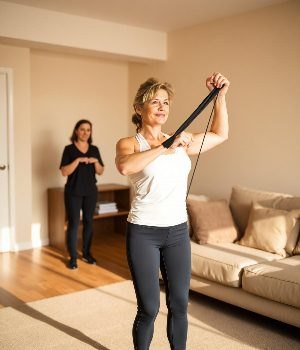
Neck pain often sneaks up on people. It may come from hours at a laptop, long drives, phone use, poor workstation setup, stress, stiffness, or an old injury that never fully resolved.
For people who work from home, commute, or spend long stretches at a desk, neck pain may also show up as headaches, shoulder tension, upper back tightness, or difficulty turning the head comfortably.
An in-home evaluation gives your therapist the chance to see your actual setup. That can include your desk, chair, screen height, pillow habits, driving posture, and the movements that trigger symptoms during the day.
We look at how your neck and shoulders behave through a normal working day, not just at end range.
Neck pain belongs under Chronic Pain Management when it is recurring, long-lasting, or affecting work, sleep, driving, or daily movement.
A dedicated page follows in a later phase; this section covers it for now.
Sciatica-like symptoms can feel different from regular back pain. You may feel pain, tingling, burning, tightness, or discomfort that travels from the low back into the hip, glute, or leg.
For some people, symptoms flare after sitting too long. For others, they show up with driving, walking, bending, stairs, or standing in one place.
We track when symptoms travel and what position settles them. That pattern usually points somewhere useful.
In-home care can be especially helpful because sciatica-like symptoms often show up during real daily movements. That may include getting out of a chair, sitting in a car, walking through the hallway, climbing stairs, or bending in the kitchen.
Sciatica-like symptoms are a primary focus of Chronic Pain Management when they are recurring, long-lasting, or affecting daily function.
A dedicated page follows in a later phase; this section covers it for now.
We Help You Understand What Is Needed Before You Start
Do you need a doctor’s referral before you call us? That question stops a lot of people cold, and it should not. In most cases, no. You can begin with a direct evaluation. New York permits a licensed physical therapist to evaluate and treat you without a physician referral for up to 10 visits or 30 days from your first treatment, whichever comes first. For long-standing pain, care often runs longer than that, and a physician referral is required to continue. We tell you that on the first call rather than at visit eleven, and we help you arrange the referral instead of leaving you stuck. Strength Works PT is credentialed with Medicare and Aetna. You know the cost of a visit before you book one, and the plan is built around how your pain is actually responding.
Some pain needs a different starting point.
Not every ache needs a physical therapist at your door. If you tweaked your back lifting a box two days ago and it is already improving, gentle movement, rest, and time may be enough.
Pain that is brand-new, mild, and improving day by day usually is not chronic pain. Chronic pain is pain that has lasted for months, keeps coming back, or has started limiting what you do.
Brand-new trauma, sudden severe pain, or symptoms that may require urgent medical attention should be evaluated by the appropriate medical provider first.
A fresh sports injury or acute strain may be a better fit for Sports Physical Therapy.
If you are just stiff from sitting at a desk all day, stretching, movement breaks, and a walk around the block may help. But if you are the parent whose knee aches every winter, the busy professional whose back flares after every commute, or the caregiver watching a loved one wince every time they stand, that is a different story.
A real look at how pain affects your life.
Not sure what happens when we walk through your door? That is one of the most common questions we hear.
Chronic pain management starts with a real look at your life, not just your chart. We watch how you get out of a chair, how you climb your stairs, how you reach for a cup in your own kitchen cabinet, and how you move through the rooms where pain actually shows up.
Many homes in this pocket of Nassau County are split-levels, with a run of narrow stairs between the front door and the living room. That layout alone can tell us a lot about where pain flares up during the day.
This first visit usually runs longer than follow-up visits. We are gathering real information, not rushing through a checklist.
Every therapist doing this evaluation is a licensed physical therapy professional.
If you are the adult child booking this for a parent, you are welcome to sit in. Most families want to hear the plan firsthand, and we would rather explain it clearly from the start.
Chronic pain happens where you actually live.
Chronic pain does not happen in a sterile clinic room. It happens on your own stairs, in your own kitchen, getting out of your own recliner, or walking from your bedroom to your bathroom at night. That is the whole point of treating it at home.
Split-levels are common in this part of Nassau County, with a short run of stairs between the entry and the living space. Those stairs are often exactly where chronic knee pain, hip pain, back pain, or balance concerns flare up.
We build your plan around that staircase, not around a clinic hallway you will never use once we leave.
Ranch-style homes are different. Everything is on one floor, which sounds easier, but it can hide problems. Without stairs to challenge your legs daily, weakness can creep in quietly. We can build specific movement into your ranch layout using hallways, doorframes, counters, chairs, and furniture you already have.

Same diagnosis, two different homes, two different plans. That is the difference a clinic visit cannot always offer. A therapist watching you climb your actual stairs may learn more in five minutes than a hallway walk in an office ever could.
Call (516) 357-4247 or request an in-home chronic pain evaluation online. We will ask about your location, symptoms, pain history, daily limitations, and what you need help with.
Request an In-Home Chronic Pain Visit →You will know the cost before anything is booked. We confirm a visit time that works around your day, explain how payment works, and tell you whether a physician referral will be needed for the length of care you are likely to need.
See Pricing & How Payment Works →Your therapist comes to your home or workplace at the scheduled time. You do not need to drive to a clinic, sit in a waiting room, or plan around parking.
Your therapist evaluates your movement, strength, mobility, symptoms, daily routine, home environment, and goals. Your plan is customized around your needs and adjusted as your care progresses.
Strength Works PT provides mobile chronic pain management in Hicksville and across Nassau County. We serve patients in nearby communities including Plainview, Syosset, Levittown, Bethpage, Massapequa, Westbury, Garden City, Mineola, New Hyde Park, East Meadow, Wantagh, and surrounding areas.
Call Strength Works PT and we can help find an available appointment time.
Because care is mobile, you do not need to plan around driving, parking, or waiting rooms.
Your therapist reviews your pain history, movement, strength, mobility, daily routine, and home setup.
The goal is to understand how pain affects your real life and build a plan around it.
No. You can begin with a direct evaluation.
New York’s direct access provisions allow a licensed physical therapist to evaluate and treat you without a physician referral, for up to 10 visits or 30 days from your first treatment, whichever comes first. If your care should continue beyond that, we will tell you what is needed and help you arrange it. If Medicare is paying for your care, your plan of care also needs to be signed by your physician, which we help arrange. Neither one holds up your first appointment.
Strength Works PT is credentialed with Medicare and Aetna. Plans differ, so call and we will check yours before anything is booked.
If your plan is not one we bill, or you would rather keep the plan out of it, you can pay for your care directly. Either way you know the cost before the first visit.
See Pricing & How Payment Works →Normal soreness usually improves within a few days.
Pain that lasts for months, keeps returning, or changes how you move is worth evaluating.
They can be.
Stairs, entryways, narrow hallways, and daily home movement can affect how pain shows up, which is why in-home care can be useful.
Back pain, neck pain, and sciatica-like symptoms are common reasons people contact us for chronic pain management.
Your therapist can look at how you move, when symptoms appear, and which daily tasks are affected, then build a plan from there.
Call if pain is limiting daily function, lasting longer than expected, or changing how you move.
If you are even a little concerned, a physical therapy evaluation can help you understand the next step without bouncing between multiple appointments first.
Seek urgent or emergency care for sudden severe pain, chest pressure, new numbness, weakness, fever, loss of bowel or bladder control, or symptoms that feel medically urgent.
A home physical therapy visit is not a replacement for emergency care.
Schedule private one-on-one care with Strength Works PT. If recurring pain, back pain, neck pain, sciatica-like symptoms, stiffness, or weakness are affecting your daily life, Strength Works PT can bring chronic pain management directly to your home or workplace. Care is available in Hicksville and across Nassau County.
Medically Reviewed by: Dr. Said Haschemi, DPT, CSCS
Review Date: Jan. 2026