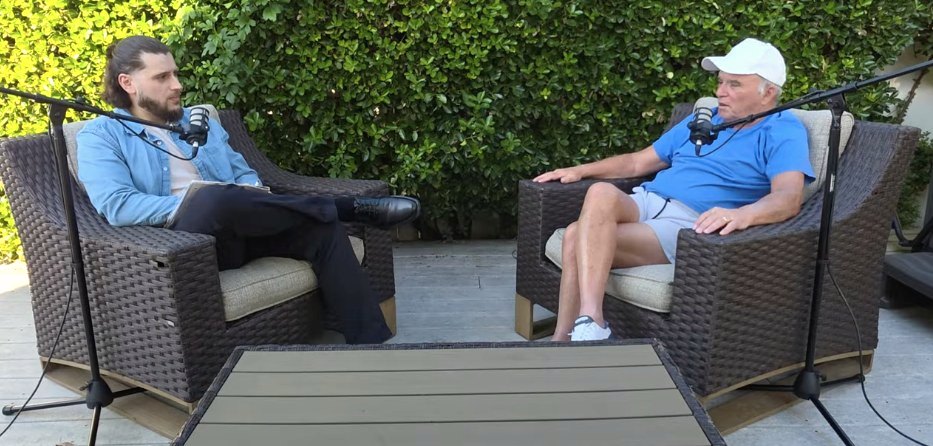
Dr. Said Haschemi: This is a series where people who have
experienced surgeries or injuries that affected their day-to-day lives share
their experiences. We dive into their stories, talk about what they endured, and
see where they are now. My name is Said Haschemi, doctor of physical therapy and
founder of Strength Works. I am here today with Bob Eilbott, a community activist
who had an emergency cervical laminectomy that affected his arms and legs. Tell
me about it, Bob. From the beginning. How did it start?
Bob: It started in April of 2024. For a couple of weeks I had
pain in my neck, headaches, backaches. It culminated around April 12th. My body
temperature went from 98 to about 102 or 103 within a matter of several minutes.
My wife rushed me to the emergency room at St. Francis Hospital in Roslyn, where
I lost control of my arms and legs. The surgeon did an MRI with contrast and
found an infection in the cervical area of my spine. He did lifesaving surgery
within a couple of hours.
At that point the surgeon was unsure what lay ahead, but he told my wife I
would need a lot of physical, occupational and other forms of therapy. After
three and a half to four weeks of rehab in two hospitals, I was able to come
home. But coming home was an ordeal, because I came home without the ability to
use my arms and legs, and for several months I could not get out of bed without
physical assistance. I had therapy at home for two or three months, and then I
was able to do outpatient physical therapy and occupational therapy as well.
Dr. Haschemi: It has been about two years since then?
Bob: Two years, three months.
Dr. Haschemi: You went from a point where you could not use
your arms and legs at all. Where are you now?
Bob: My legs are 100% better. My arms and hands are maybe 80
to 90% better. I am pretty independent as far as my life goes. I have certain
limitations. I cannot drive a car, which as a community activist I had to
be able to do. So my activism changed radically.
Dr. Haschemi: What were you told you would be capable of,
right after the surgery?
Bob: The surgeon did not give me any hope of regaining my
total independence. I was 74 when I got my health issue. I did not know what the
future held for me, or for my family.
Dr. Haschemi: Where were you mentally?
Bob: I was very depressed, that much I can say. I had been
active all the time. I could walk, run around, do basically what I wanted. And
this affected my wife to the largest extent, because she became my caregiver.
I have been married 47 years. When you get married, I do not
think you go in with the idea that you are going to be the caregiver for your
spouse.
Dr. Haschemi: How long from the first symptoms to the
surgery?
Bob: I got the surgery right away. The symptoms came very
quickly. My life changed radically within a matter of hours. When you go through
something like this you do not know where you will be four months later, or six
months, or a year. You hope you will get some of your independence back. Without
therapy, without the frequency of therapy, would I have been in this form of
recovery? The answer is no. I would not have.
Dr. Haschemi: How did your family respond?
Bob: They were so supportive from day one. I have two adult
children and four grandchildren. My grandchildren were very young at the time, seven, six, five, four and three, and they treated me like I was
grandpa.
Dr. Haschemi: And Denise?
Bob: She did everything. She was on the internet trying to
figure out what she could do and what she could buy to make my recovery
easier.
Dr. Haschemi: How was the initial rehab?
Bob: The problem was that I had an infection in the body as
well, so my blood pressure was too low to do any physical therapy. At one point
my blood pressure was something like 85 over 60.
Denise: At the first rehab there was a problem, because Bob
could not really participate. He was too weak, and he had C. diff. C. diff is
terrible. It is severe diarrhea you cannot control, and you have to be
isolated because it is contagious. So he was in a private room and could not
really work. Then we transferred to another facility and the help was not great
there either. So we came home, and we hired wonderful people to work with us.
The recovery really started in June of 2024.
Dr. Haschemi: So recovery started once you got home.
Everything before that was more about stabilizing you.
Bob: I had two physical therapists. I had an occupational
therapist. About six months in, I had a myofascial release therapist. And
swimming. Any therapy we could get, we had.
Dr. Haschemi: That is when you came to me.
Bob: June 17th. I started outpatient therapy in a clinic, and
I was still in a wheelchair. I needed physical assistance to get out of it.
Dr. Haschemi: How were you getting in and out of bed at that
point?
Bob: With two gentlemen who worked around the clock,
24 hours, seven days a week. We had a Hoyer lift, but we did not use it for long
because I had two very strong men who could help me out of bed.
Dr. Haschemi: In physical therapy we would classify that as
two-person maximum assist. That is two people at maximal effort to get
you moving. That is close to fully dependent.
Bob: I was totally dependent for everything. For feeding, for
my activities of daily living. Everything had to be done by somebody else.
Dr. Haschemi: You are one of the rare cases that goes from
fully dependent back to independent. The scary thing with nerve damage is you
never really know how much you are going to get back. You asked me many times
how much better you would get, and the answer I gave you, the same answer I
give any patient with a nerve complication, is that there is no way to
know. Give it two or three weeks, do our best, see how much change we make, and
measure the outlook from there.
Within the first few visits it was like seeing a different person walk through
that door every time. Denise showed me a video of you practicing standing. Then
one day we tried it and you got up.
Bob: A lot of screaming, a lot of nerves. But I did it. With
every improvement I said, well, what is next? I never said that is good enough.
It was: how do we get to step two?
I remember going from the wheelchair to the walker, and I hated the walker
with a passion. You said once, if you do not like the walker, do not use it. And
I walked into the clinic one day and I thought you were going to have a heart
attack, because I walked in walking. I felt that my life was coming back.
My neurologist was close to tears when he saw me, because by then it was
July or August. I was in a less invasive wheelchair, and he could not believe it
when I stood up. He said: if you train like an Olympic runner, you will make
improvement. He gave me 90%. He said, I do not know if you will walk with a
cane, I do not know if you will walk with a stick, but you will get better if
you work your butt off. And he was right.
Dr. Haschemi: What assisted you the most,
psychologically, physically, all of it?
Bob: Psychologically, when you become a quadriplegic, there
is the acceptance of it. I never accepted that I was going to be a quad. I had a
myofascial release therapist who I am still working with, and initially she
worked on the mental and psychological side of the disability. What was helpful
was that her spouse had become a paraplegic, so she knew firsthand how somebody
whose life is radically adjusted can still have as normal a life as
possible.
Physical therapy was twice a week. I had it four times a week, because I
had a personal friend who is a physical therapist and was really the coordinator
of all the care. I thank him every day. He went to school 20 years earlier, so
his modality is a little different from the way you and I work clinically. It
was good that I had all these different modalities, where I could pick and
choose a little from every therapist I had. And obviously the pool, the
aquatics, and my wife pushing me.
Dr. Haschemi: Who introduced you to aquatic therapy?
Bob: One of the gentlemen working with me, who had spent 20
years working with people with ALS. He knew things he wanted to try, and it was
trial and error a lot of the time. We started in the pool with a lift. Within a
week or so he said, that is done. He got a life jacket and adjusted it, so I
could stand a little in the water and walk a bit with that apparatus. It
progressed from that to nothing at all except walking. Within several months I
could walk in the water and get in and out of the water with help. I am still
doing therapy in the water four or five times a week, indoors or outdoors when
the weather is nice, like today.
Dr. Haschemi: People who have a laminectomy do not usually
get off scot-free. What did you deal with early on? Pain, stiffness?
Bob: My hands did not respond, and I had tingling in them. I
was given medication for it, and the medication was making me more and more
depressed, so after a short period I stopped taking it. And a lot of physical
therapy. Lots and lots.
I had stiffness in the shoulders, in the rotator cuff. I also had neck pain
from the incision, which was six inches across the back of my neck. I still
have some discomfort there, especially late in the day if I have been doing a
lot of physical activity.
Dr. Haschemi: Was one side worse than the other?
Bob: Not really.
Dr. Haschemi: That is not true. This is me as your physical
therapist now. It is very hard to recollect how bad things were from the inside,
which is why it matters to have people around you. Your right shoulder was
non-existent and in terrible pain. I even recommended Botox, to settle
the area so it was not so guarded and locked up.
Bob: I also saw a physiatrist and got shots in both
shoulders, which opened up the area so I could manipulate the shoulder
better.
You are right about the sides, though. For probably a year I was
predominantly a lefty, and for the first 73, 74 years of my life I was a righty.
I learned to pick things up and feed myself with my left hand. A little over a
year in, I could write my name with my right hand again.
Dr. Haschemi: During treatment you made me a card. I still
have it. Seeing you write your name now is very different. How are your
legs?
Bob: It took my legs a while to come back. Being a soccer
player, a skier and a walker, that was hard to understand. Once I started
walking, I would go out with one of my therapists on a Friday and we would walk
two miles.
Dr. Haschemi: You can never explain to someone how
complicated walking is until you lose the ability and try to do it again. We
take function for granted until we lose it.
Bob: I was in bed and I said, I want to get out of the bed.
My wife said, but you cannot use your legs. She asked if I wanted to go to
hospital. I said no, because I had been back twice after the initial surgery. We
called one of my personal therapists, who came at one o'clock in the morning. He
got me out of bed and put me in a reclining chair, and I slept there four or
five hours while he slept on the couch.
Dr. Haschemi: What was the drive for that?
Bob: I don't know. Maybe I was just tired of being totally
dependent and I wanted some of that independence back. That was July, one
month after coming home.
Dr. Haschemi: What setbacks did you have?
Denise: He was on an antibiotic through a PICC line, and the
antibiotic made him really sick. That is how he developed C. diff, so he went
back to hospital for three to five days. When we came home they cut the
antibiotic down a bit and it eased up. The second time, Bob had not eaten or
slept for three or four weeks. They almost gave him a spinal tap because they
thought something might be wrong cognitively, but there was not. It was from not
eating and lack of sleep. We came home around June 4th and then everything was
better.
Bob: I lost 35 pounds in five weeks.
Dr. Haschemi: Did any dietary changes or supplements
help?
Denise: We had nerve-building supplements from the health
food store for about a year and a half. We do not take them any more. I believe
they helped a lot with the tingling and the numbness. Most people
experience that for a very long time, and I feel like Bob had it for maybe three
to four weeks.
Bob: It was way longer than that.
Denise: The problem, and the reason he could not use the
walker, was the sensitivity in his hands. Everything was freezing cold or
burning hot. We tried everything. Golf gloves with the fingers cut off, garden gloves. You name it, we tried it.
Dr. Haschemi: The walker was what hurt you most, because of holding it. Your hands would feel like they were on fire. Doing it over
and over probably desensitized those nerves as they were rebuilding. Your
consistency through the week was a big part of you jumping back.
Bob: I had therapy about four hours a day.
Dr. Haschemi: You are the only person I have ever told to
back off. People think taking a step back is the thing to do with an injury,
when really you have to take ten steps forward. You took a hundred.
Bob: The neurologist said it. If your muscles do not make
contact with your nerves, the nerves are going to die.
Dr. Haschemi: That is true even for a healthy person. Back
off and the nerve endings and the fibers you build in the muscle go backwards
quickly. The good thing is that if you develop a good base, it is much easier to
get back to where you were. Where are you now versus a year ago?
Bob: I go out for a walk every morning by myself. I don't
need a shadow. To me that has made all the difference. Independence is
everything. I have been hitting a golf ball. I hit it straight now, where
I used to hook it or slice it. I have been playing lacrosse with my grandson. I
went miniature golfing with my wife and one of my personal therapists.
I had one finger on my right hand that buckled every time I tried to open it,
and I work my hands every morning after breakfast for 30 to 35 minutes. I can
shuffle a deck of cards now, which I never thought I would do. If my OT saw me
doing it she would have a heart attack, because she had been trying for the
longest time to get me to do certain things with my hands.
We were in the Cayman Islands in February with the whole family for my wife's
70th. I saw my grandchildren jumping off the side of a boat to go snorkeling
and I thought, I am going to jump in too. And I jumped in, and I could swim
around. Getting back on the boat I could not do. My son pushed me back
in. This coming Tuesday we are going to Europe for three weeks. That will be a
telltale sign of how far we have come. I really don't put any restrictions on
myself any more.
I do want to go back to doing what I love, and that is community work. It may
take a different form, and I might have to rely on my partner to pick me up in
the car, but I think it will help me mentally to see that I am worth something
again. That is the hard thing. When you get what I had, you feel absolutely
helpless, because you cannot do anything on your own and you have to rely on
people. I said early on: if I can make enough progress, maybe I can go back to
doing what I like. I did it for 25 years, in community work, mental health care
and forensics.
I remember saying to my partner, when I first started standing on my own, that
I did not want him coming back here until I could walk. I wanted that to be a
goal. If you do not make goals for yourself, you are going to stay where you
are.
Dr. Haschemi: What would you tell someone going through it
now?
Bob: That it is going to be an expensive journey, because of
the way health care is in this country today. Unless you have money, you do not get care. And you need the support of your family. I had my wife. Without her I would not be here either.
If I were a poor person, in any of the poor neighborhoods I have done advocacy
work in, you would be in a wheelchair. I thank God I had the financial
wherewithal to come back as far as I have.
Dr. Haschemi: That is a powerful message to end on. Thank you
for letting me be part of this.
Bob: If you need a physical therapist, you are the one to
get.